Sunday, July 15, 2012

Next Season: Beethoven to Beethoven, and everything in between

So, while it might seem that we simply left our blog on the vine to die, we are very much here, and excited to announce repertoire for our 2012-13 season! Here goes:

We begin with a couple of exciting collage concerts, one for a second annual Beethoven & Brewskies event at the Twin Lakes Brewery in Greenville, Delaware (a private affair - sorry), where we'll give a sampler of works by Haydn, Mozart and Beethoven (and as I type this on my iPhone, it keeps getting mis-typed as "Beerthoven", which I suppose is appropriate!).

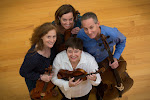
If "Beerthoven" existed, he'd look like this.

On Saturday, September 22, we take our String Quartet Time Machine to the Kennett Flash in Kennett Square, PA, giving a dash through history from Haydn to Higdon (with Mozart, Beethoven, Schumann, Dvořák, Ravel and Martinů in between). The Flash is a very fun, hip venue, and we're delighted to make our debut there.

This will mark our second season providing bookend concerts for the Arts at Trinity series in Wilmington, with some exciting repertoire and guests. October 20, 2012 (Saturday) will offer a delightful early work of Mozart (the D Major Divertimento), a middle-Beethoven classic (the "Harp" Quartet) and very youthful Dohnanyi (the Op. 1 Piano Quintet - with the fantastic pianist Victor Asuncion). We finish the Trinity season on April 20, 2013, with Puccini's gorgeous Crysanthemi, Mozart's g minor Piano Quartet (with our friend & colleague, the wonderful Julie Nishimura) and the thrilling a minor string quartet of Robert Schumann.

In March, we've got some very exciting university-related activities.  At the end of the month, we will be at Dickinson College in Carlisle, PA, for a residency.  We will be working with students, giving workshops, and presenting a performance including Haydn's "Sunrise" Quartet and the monumental Beethoven Op. 132 a minor Quartet, on March 23, 2013 (time and exact location TBA).

Earlier in March, we will present our annual concert celebrating our ongoing residency at the University of Delaware. We are delighted and honored to be Quartet-in-Residence again at UD's Department of Music, where we will continue to work with students in chamber music and give on-campus concerts and "informances".  Our formal UD concert will be in the lovely Gore Recital Hall on Sunday, March 10, 2013, at 3:00 PM, featuring the Beethoven Op. 132 and the hauntingly beautiful Il Tramonto of Respighi, with the wonderful soprano Noël Archambeault, who serves on the UD voice faculty.

Other concerts will be popping up from time to time, and members of the quartet have interesting individual and joint projects planned, but we'll save all that for another post.  Hope to see you at our concerts this coming season!

Cheers,
Larry

Saturday, February 25, 2012

How Tweet is is

So, earlier this season, we in the quartet were trying to think of interesting ways to present ourselves at our new concert series, called "ClassicAlive!" at Wilmington, Delaware's newly refurbished Queen Theater (run by World Café Live). Kate had put together a wonderful script for our first concert in December (the title of which was "Quartet Time Machine"), but we were trying to think of yet other ways to connect with our audience in this less formal, more intimate setting than an average concert.

Earlier that year, during the Super Bowl halftime show, I had a wonderful time following many people on Twitter who were making fun of the band The Black-Eyed Peas (good band, bad halftime show - still trying to wrap my head around what the heck the box-headed dancers were all about).  For some reason, the fun of this popped into my head when we were discussing the Queen Theater concerts, as did a senior recital of one of my students at the University of Delaware, who had her audience tweet about her program.  So, I said, "Hey, I could 'live-tweet' the concert while you guys are reading the script!" To my great surprise, my colleagues thought this was a really good idea. To my greater surprise, they seemed to understand what I was talking about.

So, I was off on the concept. As a trial run for the first concert, I decided to cheat a little bit.  I mostly pre-wrote my tweets to correspond to where we were in the program, adding extra tidbits like:
While Debussy loved Ravel’s 4tet, Gabriel Fauré, for whom it was written, hated it, called it a failure. Can’t please everybody! #SSQatWCL
and
In addition to being a truly wonderful composer, Jennifer #Higdon is also a truly lovely person. Double win for us! #SSQatWCL
And, some commentary about my fellow Serafins:
I promise not to tweet while Kate and Molly are playing their glorious #Mozart Duo! If you see me doing it, throw some food at me. #SSQatWCL
and
No, Kate didn't suddenly get taller. That's Tim sitting in the 1st violin seat. They share that duty - some 4tets do, most don't. #SSQatWCL
If you're unfamiliar with the weird, wacky world of Twitter, it is a site where individuals do what is called "micro-blogging", with individual "tweets" containing no more than 140 characters. The "#" sign, called a hashtag in the Twitterverse, can draw attention to a word, or comment on a tweet (in the above tweets, the hashtag simply labeled the concert).

As this concert went on, I started to feel just a bit more confident to tweet more spontaneously, and added brilliant gems like:
Yep, Kate's socks are pretty cool, indeed. #SSQatWCL
Pure poetry, huh?

The Twitter experiment was fun for me, and was sort of an exhilarating challenge, making sure I could do this stuff on my iPhone and still get myself ready to focus and play. So, I was ready to try it again for our second concert in February, a Valentine-themed concert we were calling "Romp through Romanticism". Little did I know that the idea would draw the attention of journalist Peter Bothum of the Delaware News Journal, who featured SSQ in a huge article profiling the concert and (more so) the tweeting.  Now, with pictures of the quartet, and me with my phone onstage, were all over the paper, the stakes were raised. I needed to tweet like I'd never tweeted before.  Okay, not really, but I did feel that I should be at least as active as I was the previous time out.

Some tweets from the Romanticism concert, again clearly inspired genius in 140 characters or less:
Holy cow, that Mendelssohn movement *was* fast.  My fingers are almost too tired to tweet! #repetitivestress #justkiddingimfine #SSQatWCL
Fun fact: this Ravel quartet was debuted on Tim's birthday (March 5). But Tim's not 108 years old. #SSQatWCL
and, returning to the well:
Not related to Schumann, but Kate is wearing those fabulous socks again! #SSQatWCL
The Twitter response during this concert was amazing, with people at the concert tweeting along with me, and I even got into a couple of Twitter conversations. Luckily, I always was able to get the phone down in time to play!  All in all, I had a great time doing it.

So, if you want to come and see me tweet on Sunday, March 11 at 12:00 noon at the Queen Theater (with doors opening at 11:00 for brunch), we'd love to see you.  Even if you don't come, you can always see what we're doing during the concert by following us on Twitter: @serafin4tet (you're also welcome to follow yours truly: @larrystomberg). I'll do what I can to be entertaining and informative, and maybe just a bit silly (except after we play the Barber Adagio on that concert - I'll likely be too sad to tweet).

Cheers from the quartet's head "Twit",
Larry

Friday, December 2, 2011

The Devil Is In The Details


The process of “study” is a wonderful journey. As familiarity with a subject becomes more intense, its meaning becomes clearer and richer. And as performers work into the details they find the essence of the style, structure and coherence that lies within every great work! I always took that saying “the devil is in the details” to mean that the most challenging part of playing a piece well lies in getting the details to speak and be heard!

I have equated this the experience, on some more simple level, to doing a jigsaw puzzle that replicates a great work of art or a photograph of an intricate scene. When I begin, I am primarily just matching color schemes, or connecting the most obvious and distinctive lines. But, as I get further into the process, I find myself studying the subtle nuances of the subject and getting to know the painting or photograph in great detail. My appreciation for its elements increases and my understanding of it becomes more complete. I see things to which I was initially blind – textures, figures, lines, shades of color.

Studying and mastering a musical work has something in common with this process. As I get to know a work and become more and more familiarized with the details of its elements of construction, it jumps to life at a whole new level! The process of understanding a work more and more in its intricate detail is enormously gratifying!

It is as if time slows down and I can hear the piece with more and more attention to the smallest figures. It feels as if my ears get bigger in the process – equivalent to seeing something through a magnifying glass - and I hear the elements in greater detail and I tune-in more keenly to the turn of a phrase, the articulation, the intonation of chords and scale patterns, and the unique structure and inflection of each motive and line.

Whoever it was who famously said, “the devil is in the details” (and later someone modified to say “God is in the details”), they made a compelling point. I think this is the “artist’s comment” about how attention to the intricacies elevates one’s experience of studying, playing, performing and/or listening to music! The sharper and closer is one’s perception of its elements, the more intimately we “know it”, the more deeply we experience all that it has to offer.

When a teen-ager listens over and over to his favorite song, I am sure it is not with the idea that the song is being “studied”. But I would maintain that it is exactly what is happening – with the result that the more one intently listens, the better one hears! The better one hears, the more one experiences the universe within a single musical selection.

Whether formal and “serious” or casual and for the “hobbyist”, “study” is what leads to a more and more thrilling understanding of a work of music. Familiarity is key to comprehension. So – the moral of the story is: listen often and listen intently - with your ears wide open! And, enjoy the journey to the center of each musical universe!!

-Kate


Friday, October 28, 2011

HOW DO I LOOK?


As musicians, we often spend 95% of our effort on how we sound.  But for the average audience member, a concert consists of both a visual and an audio experience.  When this involves a small ensemble looking coordinated is also a challenge.

What you wear says a lot about you. To some people, wearing jeans and a T-shirt to a performance says you do not care about the concert. But to other people it might be a “hip” statement. Pianist Awadagin Pratt often soloed with major symphonies in jeans and a T-shirt (however, he did not do this until after he won the Naumburg Competition). The Kronos Quartet also wears “non-traditional” clothes such as leather jackets and jeans. In the case of Awadagin, his fame at winning a major competition took some (but not all) of the edge off of the criticism of his dress code, and gave him a persona of an “edgy” performer. In the case of the Kronos Quartet, their dress really reflects their choice of programming, which is mainly contemporary music.

Whatever you or your group decides to wear, there are two important things to remember: 1) It needs to look like you care and 2) It needs to be true to the individual and/or the group. I personally despise performing in a tuxedo or even a suit. For me, it adds a barrier between me and the audience that I strive to remove. However, there have been times that I do perform in a suit with my quartet, because as groups there are times we want to portray a very conservative look. At other times we might perform in jeans, because the venue is different and we want to portray a different feeling. But whatever I wear, if I think I look good I will go into a concert with more confidence and security then if I am embarrassed by my dress.

-Tim Schwarz

Wednesday, October 12, 2011

LISTENING


In my last blog I talked about the power of silence. Another powerful tool is listening. Like silence, there are different levels of listening. Think about two people having a conversation. Have you ever been in a conversation with someone and feel like they are really hearing you? Contrast that with someone who is just waiting for you to stop talking so they can say what they want to say. Or talking on the phone with someone and knowing they are typing an e-mail to someone else while “listening” to you.

Music, and especially chamber music, is very similar. If I am sight-reading a piece, I spend most of my effort counting to make sure I am not off rhythmically. While this basically keeps me in the correct spot, obsession with counting can actually make me listen less. Likewise, when I really begin to listen, then it is possible I might miss-count a phrase at first. But the rewards are much greater in the end.

In order to truly listen, you have to have some knowledge of what your partners are doing. Are you with them rhythmically or tonally? What is the function of the chord or rhythm? Are you the most important voice? If not, who is? Going into a rehearsal with all of that knowledge can free you to hear the individual style and playing of the instrumentalist. And then you are truly free to communicate with each other in a meaningful way.

-Tim Schwarz

Tuesday, September 20, 2011

THE POWER OF SILENCE


On September 9-10, Serafin String Quartet held “quartet camp” at the University of Delaware, which was a series of seminars and playing exercises for quartet training. Our new violist, Molly Carr, talked about some of the things she does to prepare for a quartet rehearsal. One of the first things she mentioned was circling all of the tutti rests. I thought this was a fantastic exercise and really got me thinking about the power of silence.

All silence is not the same. The silence after a dissonant forte chord is going to be very different from the silence at the end of a piano phrase in Mozart. One of the most powerful silences I ever heard was with the Philadelphia Orchestra at the end of Tchaikovsky Symphony No. 6. That moment of complete stillness and awe in a hall filled with 2,000 people is something that can never be reproduced on a CD.  And the silence before a piece begins is equally important, and can also vary tremendously. 

One of the reasons silence is so powerful is it is something both the audience and the performers participate in equally. The performers have to set up the silence well, but the audience has to participate in it fully for it to be truly effective. Silence is always the time that I know if the audience is “with” me or not.

So the next time you are performing a piece, don’t just think about the notes. Think about those moments of silence which are so incredibly powerful.

-Tim Schwarz

Tuesday, April 5, 2011

Truckin' Through the South

Long time, no blog.  Well, after a long, crazy couple of months, we're back online, and will be sharing some fun tidbits about our upcoming southern US tour!

We'll be spending a few days in beautiful and bustling Atlanta, Georgia, for two performances at Emory University.  Our concert on Friday, April 8, will be introduced by Atlanta Symphony Orchestra maestro and new head of the Aspen Festival and School, Robert Spano.  We'll also be playing a children's concert, on Sunday, April 10, featuring the animals Webster the Musical Spider and Ferdinand the Bull, at Emory's Carlos Museum.

From there, we travel to Spartanburg, South Carolina, for a Monday evening concert (April 11) at Wofford College, presenting some meaty repertoire of Dvořák and Beethoven.  Then we'll be on the way back home.

So, stay posted, as we'll hope to blog about our travels, with some fun pictures to boot.  Okay, off to go pack and put gas in the car...

Cheers,
Larry & SSQ

Friday, August 27, 2010

Quartet Residency at the University of Delaware

Hi everyone, Larry here - long time, no post.

Many of you have likely heard by now about our new Quartet-in-Residence position at the University of Delaware, the school where I also teach as Associate Professor of Cello.  We're very excited about the honor and the opportunity (we start Monday!), and I thought I'd share a bit about what we'll be doing.

While some groups take a residency position strictly to have a home base to perform and rehearse, SSQ's aim is to be as important a part of the community for students as we can be.  Of course, we'll also be at the UD Music Department as a home base, and will be doing rehearsals there every week and giving some concerts, but we see our function as to help enhance the experience for the music students, particularly the string players.

In addition to rehearsing on our days at UD (most every Monday with some other days sprinkled in throughout the year), we'll be working with student chamber ensembles, presenting "informances" in the Music Department and at other venues on the campus, and collaborating with other faculty.  Just a few things in our first two weeks of the residency!:
  1. We'll be hearing orchestra and chamber music auditions this coming Monday, to help place students in chamber groups that will hopefully thrive.
  2. On September 10th, during the Department's General Student Recital (a weekly Music Student Convocation), we'll formally introduce ourselves to the student body, performing some of the repertoire from our upcoming season, including a movement of the Brahms Clarinet Quintet with wonderful clarinetist and UD faculty member Marianne Gythfeldt.
  3. On September 13th and 15th, we'll be giving string sectionals to the students in the UD Symphony Orchestra.
  4. Also on the 15th, we'll be presenting the inaugural lunchtime concert for a series at UD's Institute for Global Studies, in a lovely little building that was built before 1775!
So, we're starting off with a bang, and are looking forward to even more interaction with the students, faculty and patrons of the entire university.  There's a lot planned for the year, and we'll keep you posted.

We're very thankful to the University of Delaware's Department of Music and its chair, Paul Head, who helped facilitate all of this with the generous assistance of an outside donor.  SSQ is hopeful that this will be a relationship that can grow and prosper as the years go by.

One concern we have, however, and that I have had to battle with (as a faculty member for 6 years now), is the school's mascot.  If you don't know, Delaware is known as the Fightin' Blue Hens (an honorific back in Revolutionary days for someone who was tough and fierce).  That's all well and good, but "YouDee", our particular Fightin' Blue Hen mascot, looks like this:

We're not sure quite how to come to grips with this.

Cheers,
Larry

Tuesday, June 29, 2010

Kate and Tim's Beethoven Sonatas Odyssey!

by Kate

I can’t help reflecting on our amazing Beethoven experience, having just returned from the culminating week of our Beethoven violin sonatas project.  As an off-shoot of Serafin String Quartet’s performance activity, Tim and I presented all ten Beethoven violin/piano sonatas with five different pianists, on three different series in 4 states, between March and June 2010. A Beethoven Odyssey, indeed!
I have wanted to revisit these great works, having played all 10 with my brother, William, on a series in Florida in the late 1990's. I had the idea to do so with my SSQ colleague, Tim, and with a number of pianists. Tim seemed keen to join in on the project, and we ended up being able to present all 10 sonatas on three series (Wilmington, DE; Abington, PA; and at Classicopia Festival in VT and NH). We performed a total of 12 concerts and collaborated with 5 pianists - each interesting and wonderful in their own right! Tim and I each played all 10 sonatas - taking 5 each in the first run, and then switching.

In the final concert in Norwich, New Hampshire, on June 20th, Tim concluded our adventure playing, after intermission, the “Kreutzer Sonata” like a real champion, following my romp through the A Minor (#2) and the “little G Major” (#8) on the first half. I must admit to a tiny tinge of professional jealousy at his stealing the show – but that was quickly and completely overtaken by my collegial pride at his fine playing (and also by my relief that it was not my turn to play the “Kreutzer” in the 90-degree, un-air-conditioned church where the series was held!!).  It was so hot and humid that the pianist quickly turned his handkerchief into a dripping washcloth, and up-ended a cup of water (partially onto the keyboard’s octave below “middle C”!!) when he too hastily reached to quench his thirst after the furious first movement.

Aside from this very famous Sonata #9 in A Major (written about by Tolstoy and usually chosen above all other sonatas by every violin virtuoso programming a recital) many of these ten masterworks are little-known, even by violinists, and most are rarely performed. And, as Tim and I discovered – oh, what everyone is missing!!

Our first discovery was that each and every one of the ten sonatas is a masterwork and a gem in the repertoire. The next thing we found out is  - they are all tricky and difficult to master!! The relationship of these works to the majesty and intimacy of the 17 string quartets is resonating with me profoundly as Serafin Quartet starts work on the String Quartets Op. 18#2 and Op. 132 - both of which SSQ will perform in the 2010-11 season. I feel that, due to this amazing sonatas project, I have a deepend understanding and stylistic conviction about Beethoven and his chamber music. It is such incredible art that it never grows old or dull. There is always more to discover - and I look forward to sharing that with my quartet colleagues and the audiences next season!